📰 TN TODAY·Today's most important story from Tamil Nadu
Published daily at 8:00 AM
🚌 TRANSPORT

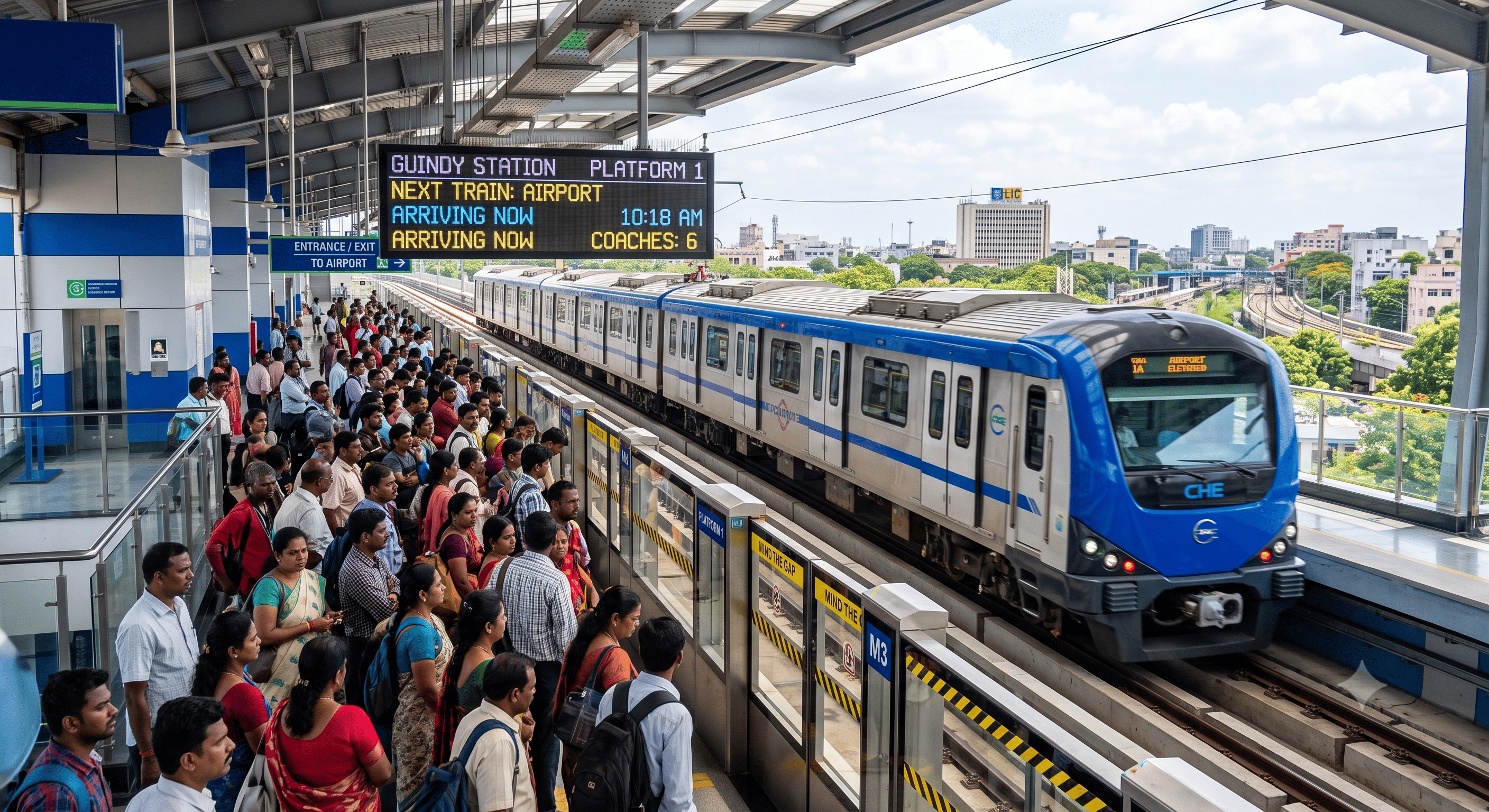
Chennai Metro Set for Major Upgrade: 28 New Six-Coach Trains to Transform Daily Commute

Chennai Metro Rail Limited appoints procurement consultant for 28 new six-coach trains and station upgrades, targeting reduced wait times and higher daily ridership across the city's Phase I network.
23 July 2026VizhiTN Editorial Team5 min read
Chennai Metro Set for Major Upgrade: 28 New Six-Coach Trains to Transform Daily Commute

Why this matters to Tamil Nadu

Chennai's public transport network is under daily pressure from millions of commuters. When metro capacity fails to keep pace with ridership growth, passengers spill over onto roads, increasing congestion, travel time, and air pollution. The 28-train procurement with six-coach formations directly addresses this capacity gap. For residents who rely on the metro for daily commuting, the reduction in wait times and crowding translates into concrete improvements in quality of life, travel predictability, and daily stress levels. This is urban infrastructure investment that touches ordinary Chennaians every working day.

A Growing City, A Stretched Network

Chennai's urban population has expanded steadily over the past decade, and the pressure on its public transport systems shows no signs of easing. The Chennai Metro Rail Limited currently operates 45 four-coach trains across a 54-kilometre network that connects Chennai Airport with Wimco Nagar on one corridor and St Thomas Mount with Chennai Central on another. On a typical weekday, approximately 3.2 lakh passengers depend on these services to navigate the city. During morning and evening rush hours, trains often run at capacity, leaving commuters to wait for the next service.

The decision to procure 28 new six-coach trains addresses this strain directly. By increasing the carrying capacity per train run, CMRL can move significantly more passengers within the same number of departures, or alternatively maintain ridership levels while improving frequency. Either outcome brings meaningful relief to daily commuters struggling with overcrowding.

What the Procurement Means in Practice

CMRL's appointment of a procurement consultant signals that the project has moved from planning into active execution. The consultant will manage the detailed technical specifications, tendering process, and supplier evaluation needed to bring 28 new six-coach trainsets into service. The procurement follows an established pattern; the broader Phase II network, currently under construction and expected to be completed by 2028, will feature fully driverless trains operating at Grade of Automation 4 (GoA4), reflecting CMRL's intent to bring world-class metro technology to Chennai.

The Phase I upgrade focuses specifically on lengthening train formations from four to six coaches. This change means each train can carry approximately 50 percent more passengers per trip. While this sounds straightforward, it requires corresponding upgrades to station platforms, which must be extended to accommodate the additional length. CMRL has identified 21 stations that will require this work, and the process involves not only construction but also electrical system upgrades and the installation of platform screen doors that synchronise with train doors for safety.

Station Upgrades and Depot Expansion

Platform screen doors are a particularly important element of the upgrade. Currently, Phase I stations do not universally feature this safety infrastructure. Screen doors create a sealed barrier between the platform and the track, preventing accidental falls onto the rail and improving platform air conditioning efficiency. Their installation is necessary before six-coach trains can operate safely at upgraded stations, making this a prerequisite rather than an optional enhancement.

Depot capacity is another critical enabler. The Koyambedu and Wimco Nagar maintenance depots handle the inspection, servicing, and overnight stabling of the existing four-coach fleet. Adding 28 larger trainsets requires expanded yard space, additional maintenance bays, and upgraded workshop facilities. CMRL's plan includes these depot expansions as integral components of the overall capacity enhancement, ensuring that the new fleet can be maintained to the same operational standards as existing trains.

Impact on Commuters: Wait Times and Frequency

The most tangible benefit for daily passengers will be reduced waiting times. CMRL's target is to bring peak-hour headways down to between three and five minutes once the new trains are in service. Currently, passengers at many Phase I stations wait longer during off-peak hours and experience crowding during rush periods. A three-to-five-minute frequency transforms the metro from a scheduled service into an on-demand mode of travel, fundamentally changing how commuters plan and experience their journeys.

For residents of areas served by the Phase I corridors — including Koyambedu, Anna Nagar, Thirumangalam, Alandur, and the airport zone — this improvement has direct implications for daily commuting time, workplace punctuality, and the overall attractiveness of public transport relative to private vehicles. When metro services become fast and reliable at short intervals, the incentive to use personal cars or two-wheelers diminishes, contributing to reduced congestion and lower urban emissions.

Context: Phase II Launch on the Horizon

The Phase I upgrade does not exist in isolation. Chennai Metro's Phase II project will add approximately 118.9 kilometres of new lines, extending coverage across the north-south and east-west axes of the city. The Poonamallee Bypass to Vadapalani corridor, spanning 14.6 kilometres, is the first Phase II stretch nearing launch readiness. As of early July 2026, CMRL had received 34 of 36 ordered trainsets for Phase II, with the remaining sets expected at Poonamallee depot shortly. The corridor has received safety clearance from the Commissioner of Metro Rail Safety but awaits an official launch date.

The combination of Phase I expansion and Phase II inauguration will meaningfully transform Chennai's urban mobility landscape within the next two years. Commuters in parts of the city currently underserved by rapid transit will gain access to the metro network for the first time, while existing users will benefit from higher frequency and greater capacity on established routes.

Yamaha's Chennai Export Hub Plans Add Economic Context

The transport sector upgrades come alongside significant industrial investment in Chennai. Japanese motorcycle manufacturer Yamaha announced plans on July 20th to reposition its Chennai manufacturing facility as a major global export hub covering both internal combustion engine vehicles and electric vehicles. This investment reinforces Chennai's standing as a central node in India's automotive manufacturing ecosystem, and it points to rising employment and economic activity in the metropolitan area — further reinforcing demand for upgraded public transport infrastructure.

Looking Ahead

The Chennai Metro expansion initiative reflects a broader recognition that urban transport investment pays dividends across multiple dimensions: it reduces road congestion, lowers per-commuter emissions, improves air quality, and creates economic value by connecting workers to employment centres more efficiently. For a city of Chennai's scale and growth trajectory, metro capacity is not a luxury but a necessity.

The completion timeline for the Phase I six-coach upgrade will depend on procurement timelines and construction schedules for platform extensions. CMRL has not specified a firm completion date, but the urgency reflected in the appointment of a procurement consultant suggests the organization is treating this as a priority initiative. Residents and daily commuters should expect phased improvements as individual stations are upgraded and new trains progressively enter service over the coming months and years.

Key Highlights

Chennai Metro Rail Limited (CMRL) currently operates 45 four-coach trains across its 54-km Phase I network.
The Chennai Metro records an average daily ridership of approximately 3.2 lakh passengers.
CMRL plans to procure 28 new six-coach trains to increase passenger capacity on the Phase I and Phase I Extension corridors.
Twenty-one metro stations will undergo platform extensions, platform screen door installation, and electrical upgrades to support six-coach operations.
The upgrade aims to reduce peak-hour waiting times to between 3 and 5 minutes, improving commuter convenience.
Koyambedu and Wimco Nagar depots will be expanded to maintain and service the larger metro fleet.
Chennai Metro Phase II will add approximately 118.9 km of new metro corridors across the city.
The Phase II network is expected to feature fully driverless trains (Grade of Automation 4 - GoA4) and is targeted for completion by 2028.

🕐Timeline

2007: Chennai Metro Rail Limited (CMRL) was established as a joint venture between the Government of India and the Government of Tamil Nadu.
2016: The Government of India approved the Chennai Metro Phase II project, paving the way for the city's largest metro expansion.
April 2026: The Poonamallee Bypass–Vadapalani corridor received safety clearance from the Commissioner of Metro Rail Safety (CMRS).
July 2026: CMRL received 34 of the 36 trainsets for Phase II, with the remaining trainsets arriving at the Poonamallee depot.
July 20, 2026: CMRL announced the appointment of a procurement consultant to acquire 28 new six-coach trains for the Phase I and Phase I Extension network.
2028 (Target): The full Chennai Metro Phase II network is expected to become operational.

Join the Conversation

View Discussion

Share your views, ask questions, and stay updated with your community.

Share this story

Stay updated with TN Today

Get the day's top story delivered to your inbox every morning.