📰 TN TODAY·Today's most important story from Tamil Nadu
Published daily at 8:00 AM
👥 SOCIAL

International Counterfeit Currency Ring Dismantled: Chennai Police Uncover Pakistan and Malaysia Links

Tamil Nadu Police and CB-CID dismantle sophisticated fake currency operation with international connections, seizing counterfeit notes worth ₹11 lakh and investigating cross-border criminal network.
23 July 2026VizhiTN Editorial Team5 min read
International Counterfeit Currency Ring Dismantled: Chennai Police Uncover Pakistan and Malaysia Links

Why this matters to Tamil Nadu

Counterfeiting directly threatens the economic system that citizens and businesses depend on for commerce and daily transactions. When counterfeit currency circulates, individuals and businesses suffer losses, confidence in currency declines, and transaction costs increase as people employ additional authentication measures. International counterfeiting operations are particularly concerning because they demonstrate sophisticated criminal coordination and suggest potential connections to terror financing or other organized crime networks. Dismantling these operations protects not only individual citizens and businesses but also maintains the integrity of India's financial systems.

Major Counterfeiting Operation Exposed

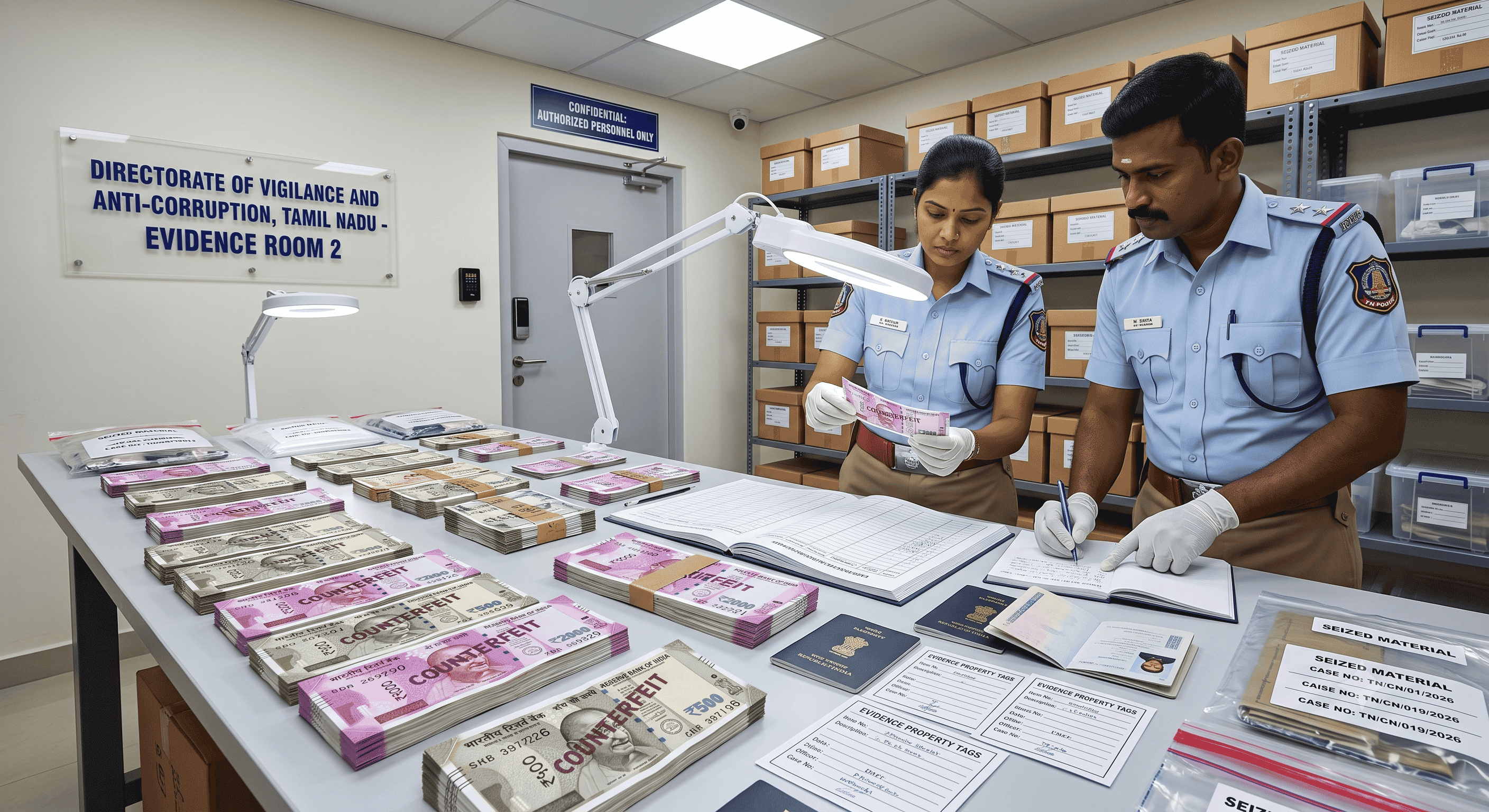
Tamil Nadu Police arrested Shafiq Rahman (37) at a private lodge in the Triplicane area of Chennai on July 15th, 2026, while he was in possession of counterfeit Indian currency notes with a face value of approximately ₹11 lakh. The arrest triggered subsequent investigations that revealed a larger criminal network extending beyond Chennai and involving operatives across multiple states and international locations.

Initial searches at the lodge where Rahman was apprehended recovered not only counterfeit currency but also genuine cash in significant quantities, foreign currency including Euro notes, multiple passports belonging to different individuals, and mobile phones used for coordination within the criminal network. These items indicated a sophisticated operation rather than isolated counterfeiting activity.

Network Investigation Reveals International Connections

Following Rahman's arrest, police investigation led to the apprehension of Ravichandran (40), an original resident of Thanjavur district, from whom additional counterfeit currency notes and some Euro currency were seized. Sustained interrogation of both individuals revealed the existence of an international criminal network with key operatives based in Malaysia.

Police investigations identified a woman named Parimala, reportedly based in Malaysia, as a central figure in the counterfeiting network. Intelligence gathered during interrogations indicated that Parimala had stayed at a private hotel in T Nagar, Chennai for nearly a month and allegedly supplied counterfeit currency to Ravichandran during her residence in the city. The investigation established that Parimala had returned to Malaysia just two days before Ravichandran's arrest, suggesting coordination in operations and potential awareness of impending enforcement action.

Malaysian National Detained at Airport

Acting on further intelligence developed during interrogation of arrested operatives, police detained Bhuvaneshwari, a Malaysian national, at Chennai International Airport on a subsequent date while she was preparing to board a flight returning to Malaysia. Preliminary investigations indicated that Bhuvaneshwari had shared hotel accommodation with Parimala during the latter's stay in Chennai, suggesting coordination in the criminal operation and possible involvement in logistics for transporting counterfeit currency.

The presence of foreign nationals actively involved in counterfeiting operations within Tamil Nadu raises concerns about international organized crime networks utilizing Indian territory for illegal currency production and distribution. The involvement of Malaysian operatives working in conjunction with domestic participants indicates structured coordination rather than ad-hoc criminal activity.

Smuggling Allegations and Terror Links

Police suspect that the criminal network had been systematically smuggling counterfeit Indian currency from Malaysia into Tamil Nadu and subsequently circulating it through local commercial channels. The scale of counterfeit notes recovered and the sophistication of coordination between operatives suggest sustained smuggling rather than isolated incidents.

Investigators are probing potential involvement of terror groups in the counterfeiting operation, as some accused individuals had reportedly travelled regularly to Pakistan and Malaysia. Terror organizations have historically exploited counterfeiting operations as funding mechanisms and as tools for destabilizing national economies. The involvement of international travel patterns and international financial networks indicates capabilities consistent with organized criminal or terror-related operations rather than street-level counterfeiting.

Related Counterfeiting Cases

The Chennai operation represents one of several counterfeit currency cases that Tamil Nadu Police have addressed in recent months. In May 2026, Coimbatore Police arrested Satham Hussain (38), Faisal (38), and Hakkim (51) for allegedly running a fake currency printing operation from a house in the Kurichi Housing Unit area. Following that arrest, police apprehended Sahabudeen, alias Khaja Moideen, for allegedly procuring and supplying the counterfeit currency printing machinery to the accused trio.

In October 2025, Ranipet Town Police arrested five persons for allegedly circulating counterfeit Rs 500 notes in Walajah, Arcot, Sholinghur, and Arakkonam towns in the district. The pattern of multiple counterfeiting cases across different districts indicates that organized counterfeiting represents an ongoing challenge rather than isolated criminal incidents.

Impact on Monetary System and Public Trust

Counterfeiting of currency undermines the stability of the monetary system and erodes public trust in financial transactions. When counterfeit notes circulate in the economy, businesses and individuals face uncertainty regarding the authenticity of currency they receive. This uncertainty can lead to increased transaction costs as individuals employ authentication procedures, and can reduce velocity of currency circulation as people hold money longer while verifying authenticity.

Traders, shopkeepers, and ordinary citizens who accidentally receive counterfeit notes suffer direct financial losses. The longer counterfeit notes remain in circulation before detection, the greater the cumulative economic damage. Investigation and prosecution of counterfeiting networks protects the integrity of the monetary system and reduces losses to individuals and businesses.

Investigation Methodology and International Cooperation

Effective investigation of international counterfeiting networks requires cooperation between state police, central investigative agencies, and international law enforcement bodies. Tamil Nadu Police worked in coordination with CB-CID, and investigations likely involved intelligence sharing with international agencies investigating terror financing and organized crime. The joint investigation approach involving Triplicane Police, Integrated Crime Investigation Wing, CB-CID, and central intelligence agencies demonstrates multi-agency coordination.

The investigation methodologies included surveillance of suspects, analysis of money flow patterns, tracking of international travel, and coordination with hotel management and airport authorities to gather evidence regarding the movements and activities of foreign operatives within Indian territory.

Ongoing Investigation and Public Safety

Investigations are ongoing to identify the full extent of the counterfeit currency network and trace other individuals involved in production, distribution, and circulation of fake currency. Police have established that the counterfeiting operation extended across multiple states and involved coordination with international operatives, indicating that arrests and seizures thus far represent only partial disruption of the overall network.

The investigation will likely expand to examine money laundering channels through which proceeds from counterfeiting and related criminal activities were transferred to international accounts, identify printing facilities and equipment suppliers that contributed to the counterfeiting operation, and determine whether the counterfeiting network was connected to other organized criminal activities.

Key Highlights

Shafiq Rahman was arrested on 15 July 2026 at a lodge in Triplicane, Chennai, with counterfeit currency worth ₹11 lakh.
Police seized counterfeit notes worth ₹11 lakh, genuine cash amounting to ₹11.21 lakh, and €25,000 in Euro currency during the operation.
Thirteen passports were recovered from the accused, indicating the involvement of multiple operatives with international travel links.
Ravichandran was arrested following Rahman's capture, and his interrogation reportedly helped investigators uncover the wider network.
Parimala, believed to be based in Malaysia, was identified as a key figure in the alleged counterfeit currency racket.
Bhuvaneshwari, a Malaysian national, was detained at Chennai International Airport while allegedly attempting to leave the country.
Investigators suspect the network may have links to organized crime syndicates and terror financing, with further inquiries underway.
Police allege that the counterfeit currency was smuggled from Malaysia into Tamil Nadu for circulation across the state.

🕐Timeline

May 2026: Coimbatore Police arrested three individuals for allegedly operating a counterfeit currency printing unit from a residential location.
July 15, 2026: Shafiq Rahman was arrested at a lodge in Triplicane, Chennai, with counterfeit currency worth ₹11 lakh.
July 15–18, 2026: Ravichandran was arrested, and his interrogation reportedly revealed links to an international counterfeit currency network.
July 18–22, 2026: Bhuvaneshwari, a Malaysian national, was detained at Chennai International Airport, as investigators expanded the probe to identify the full extent of the network.
Next Stage: Police are continuing investigations to trace additional suspects, verify international links, and determine the involvement of organized crime or other groups in the alleged counterfeiting operation.

Join the Conversation

View Discussion

Share your views, ask questions, and stay updated with your community.

Share this story

Stay updated with TN Today

Get the day's top story delivered to your inbox every morning.