📰 TN TODAY·Today's most important story from Tamil Nadu
Published daily at 8:00 AM
🏛️ GOVERNANCE

Greater Chennai Corporation Extends Property Tax Deadline to July 31 as Collection Campaign Progresses

Civic body grants additional two weeks for property tax payment as 7.25 lakh owners remain outstanding; collection camps operating across city zones.
23 July 2026VizhiTN Editorial Team6 min read
Greater Chennai Corporation Extends Property Tax Deadline to July 31 as Collection Campaign Progresses

Why this matters to Tamil Nadu

Property tax funds essential civic services that directly impact daily life including garbage collection, water supply, road maintenance, and emergency services. When property owners delay tax payment, the corporation faces reduced capacity to maintain these services and provide regular infrastructure improvements. By meeting the July 31st deadline, property owners ensure that the corporation receives funding necessary for uninterrupted, high-quality civic service delivery. Additionally, timely payment avoids penalties and potential legal complications that may affect property rights.

Critical Revenue Source for Municipal Services

Property tax represents the Greater Chennai Corporation's most important revenue source, generating approximately ₹1,800 crore annually under normal circumstances. This revenue directly funds essential civic services including garbage collection and waste management, maintenance of municipal infrastructure, water distribution systems, street lighting, road repairs, and emergency services. When property owners delay tax payments, the corporation faces reduced capacity to fund these critical services, potentially affecting service quality and frequency across residential and commercial areas.

The civic body's ability to provide consistent, high-quality services depends on predictable revenue collection. Delays in property tax payments create uncertainty in departmental budgeting and force officials to postpone maintenance and improvement activities. The extended collection campaign aims to accelerate payments and ensure that the corporation receives funding necessary for uninterrupted service delivery throughout the fiscal year.

Collection Campaign Timeline and Response

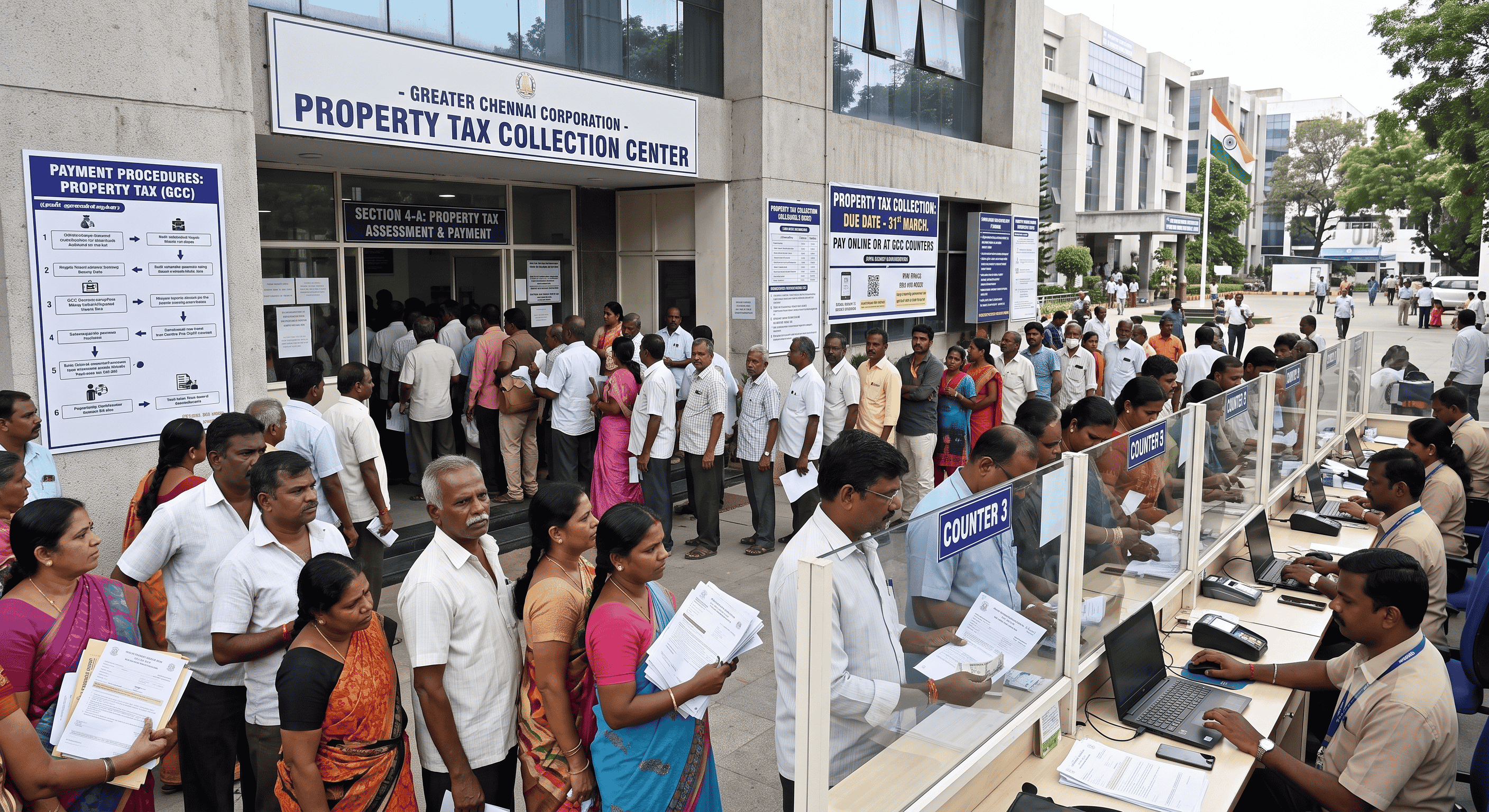
The Greater Chennai Corporation launched special property tax collection camps on July 3rd, 2026, with an initial deadline of July 17th. The special camps operate across all 15 zones of the city through dedicated tax collection centers located at zonal and ward offices. Operating hours extend from 8:00 AM to 6:00 PM on all working days, providing convenient access to citizens with varying schedules.

During the first phase of the collection campaign between July 3rd and July 15th, the corporation collected approximately ₹96 crore, indicating positive response from property owners who paid their dues during the initial period. However, with 7.25 lakh property owners remaining outstanding as of July 15th, officials recognized that an additional two-week extension would be necessary to encourage further compliance before the close of the fiscal term.

Outstanding Payment Statistics

According to Greater Chennai Corporation assessment records, the total number of assessed residential and commercial properties across Chennai stands at 14.23 lakh units. The payment breakdown reveals that 6.98 lakh property owners (approximately 49 percent) have successfully paid their property tax dues during the collection campaign period. The remaining 7.25 lakh property owners (approximately 51 percent) have outstanding tax obligations ranging from current fiscal year payments to potentially accumulated arrears from previous years.

Officials indicate that residential properties demonstrate higher payment rates than commercial establishments, suggesting that owner-occupied residential properties have better compliance patterns compared to investment properties or commercial real estate. The pattern reflects varying motivations: homeowners may prioritize tax payment to maintain property titles and avoid legal complications, while commercial property owners may delay payment to preserve working capital.

Payment Methods and Accessibility

The Greater Chennai Corporation has implemented multiple payment options to maximize accessibility and encourage compliance. Property owners can pay taxes through several channels including in-person payment at collection camps located at zonal and ward offices, online payment through the GCC website portal, and mobile payment applications including Namma Chennai App, Paytm, and BHIM UPI.

The diversity of payment methods recognizes varying preferences among residents. Older residents and those less comfortable with digital technology can pay in person at physical collection centers. Technology-comfortable residents can complete payments online from home using various digital platforms. Commercial establishments and corporate entities can process bulk payments through institutional accounts. This multi-channel approach removes barriers to payment and accommodates diverse payment preferences.

Incentive Structure and Penalty Provisions

The corporation offers financial incentives to encourage timely payment. Property owners who pay their tax dues within the designated incentive period receive approximately 5 percent discount on the total tax amount, effectively reducing their actual tax liability. This incentive structure rewards prompt payment and generates faster revenue collection for the civic body.

Conversely, property owners who fail to pay by the deadline face penalties including penal interest charges on outstanding amounts. The penalty provisions create financial consequences for non-compliance and provide incentive for payment within the deadline period. The combination of positive incentive (discount for early payment) and negative consequence (penalties for non-payment) creates a balanced motivational structure.

Use of Property Tax Revenue

Property tax revenue collected by the Greater Chennai Corporation funds a comprehensive range of municipal services and infrastructure maintenance. Revenue allocation includes solid waste management operations including landfill maintenance, garbage vehicle operations, and waste processing facilities. Additionally, revenue funds road maintenance programs, street lighting systems, water supply network maintenance, sewerage system operations, health and sanitation programs, and disaster response and emergency services.

The scale of property tax collections directly correlates with service quality and frequency. When collection rates are high and revenue is predictable, the corporation can maintain regular maintenance schedules, upgrade aging infrastructure, and respond promptly to emergency service requests. When collection rates are low, the corporation faces constraints that may delay maintenance, reduce service frequency, or defer infrastructure upgrades.

Digital Payment Security and Verification

Property owners utilizing online or mobile payment options benefit from encrypted digital transactions and immediate payment confirmation. The GCC website portal and mobile applications provide transaction verification through official receipts and payment acknowledgments. Digital payment channels also provide transaction records useful for future reference and property-related documentation.

The corporation has implemented security measures to prevent fraudulent transactions and unauthorized access to payment systems. Property owners should ensure they access payment systems through official GCC channels and avoid sharing payment information through unsecured methods or unofficial third-party applications.

Addressing Non-Compliance and Default Cases

Property owners with substantial outstanding arrears or persistent non-compliance face additional legal consequences beyond penalties. The corporation can initiate property attachment proceedings or pursue legal recovery action against property owners with significant tax liabilities. In extreme cases, the corporation can prevent property transfer or registration until outstanding tax obligations are cleared.

The corporation emphasizes that timely payment protects property owners' rights and avoids these escalated enforcement measures. Property owners experiencing financial difficulties or unable to pay in full can contact the corporation to arrange payment plans or discuss eligibility for any available exemptions or relief provisions.

Impact on Municipal Service Capacity

The timely collection of property tax is not merely an administrative objective but directly affects residents' quality of life through service provision. Roads maintained through property tax revenue are safer for pedestrians and vehicles. Street lighting funded through property tax collections enhances public safety after dark. Water distribution systems funded through property tax collections provide safe drinking water access. The deadline extension aims to ensure that these services receive adequate funding for uninterrupted provision.

Key Highlights

The Greater Chennai Corporation (GCC) has assessed 14.23 lakh properties for property tax collection.
As of 15 July 2026, 6.98 lakh property owners (around 49%) had paid their property tax.
Around 7.25 lakh property owners (approximately 51%) are yet to pay their dues.
The GCC collected approximately ₹96 crore during the special property tax drive held between 3 July and 15 July 2026.
Property tax contributes around ₹1,800 crore annually to the Greater Chennai Corporation's revenue.
Eligible taxpayers can receive an early payment incentive of about 5% on their property tax.
Property tax can be paid through zonal offices, the GCC online portal, the Namma Chennai App, Paytm, and BHIM UPI.
Special collection camps are operating from 8: 00 AM to 6:00 PM on working days to facilitate tax payments.

🕐Timeline

July 3, 2026: Greater Chennai Corporation launched a special property tax collection campaign across all 15 city zones.
July 15, 2026: The initial collection period concluded, with ₹96 crore collected and 6.98 lakh properties clearing their dues.
July 16, 2026: GCC announced an extension of the property tax collection campaign until 31 July 2026.
July 17, 2026: The original deadline for the special collection drive, before the extension was announced.
July 31, 2026: Extended deadline for property tax payment. Penalties may apply to unpaid properties after this date.

Join the Conversation

View Discussion

Share your views, ask questions, and stay updated with your community.

Share this story

Stay updated with TN Today

Get the day's top story delivered to your inbox every morning.