📰 TN TODAY·Today's most important story from Tamil Nadu
Published daily at 8:00 AM
📰 GENERAL

Study Warns: Proposed Semmencherry Global Sports City May Heighten Chennai's Flood Vulnerability

Environmental research raises concerns that large-scale sports city development could exacerbate urban flooding risk through ecosystem disruption and drainage alteration.
22 July 2026VizhiTN Editorial Team6 min read
Study Warns: Proposed Semmencherry Global Sports City May Heighten Chennai's Flood Vulnerability

Why this matters to Tamil Nadu

Flooding causes loss of life, destroys property, disrupts livelihoods, and overwhelms municipal services. Urban planning decisions that increase flood vulnerability impose risks on millions of residents and damage valuable infrastructure. When development projects inadvertently increase flood risk, these risks are borne by broader populations, including vulnerable groups with limited ability to recover from flood losses. Integrating flood mitigation into development project design protects residents from increased disaster risk and ensures that urban growth enhances rather than undermines quality of life.

Semmencherry Area and Environmental Context

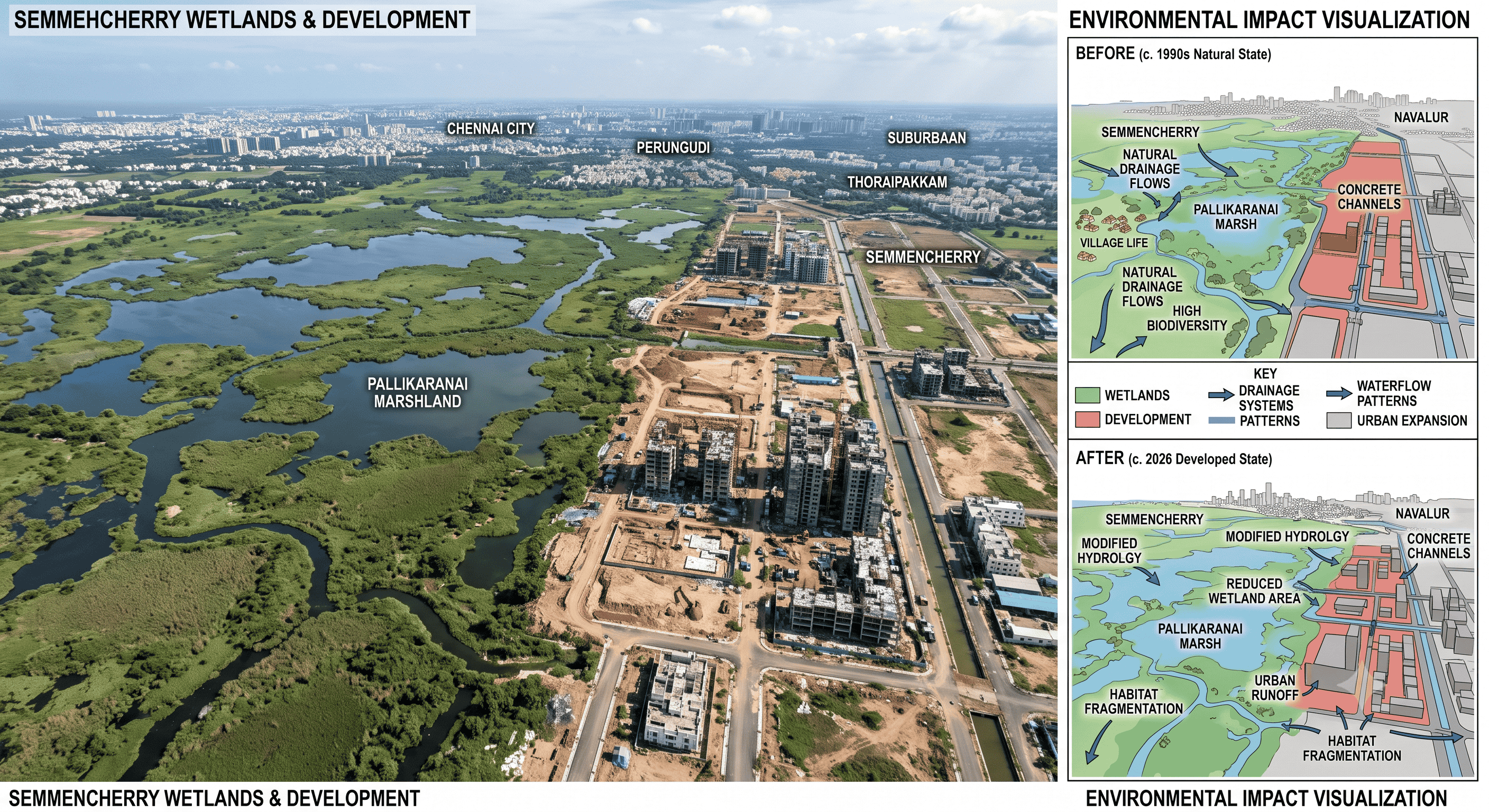
The Semmencherry area on Chennai's southern periphery has historically been characterized by wetland ecosystems including marshlands and seasonal water bodies. These natural features function as ecological infrastructure providing multiple services including water retention during monsoon precipitation events, groundwater recharge, and biodiversity habitat. The region's topography and hydrological characteristics have influenced settlement patterns and water management considerations for surrounding communities.

The proposed Semmencherry Global Sports City represents a large-scale urban development initiative intended to create comprehensive sports facilities, training centers, and residential infrastructure. The project scope encompasses significant land area conversion from existing ecological uses to urban built environments including sports complexes, accommodation facilities, roads, and associated infrastructure.

Environmental Study Findings

The environmental research released on July 22nd analyzed potential impacts of the Semmencherry Global Sports City development on the city's flood vulnerability. The study's conclusions indicate that the proposed development pattern could potentially heighten Chennai's flood risk through several mechanisms. Primary concerns identified include disruption of natural water retention areas, alteration of natural drainage patterns, reduction in infiltration capacity of developed areas, and potential blocking of historical water flow pathways.

The researchers emphasized that natural wetlands and marshlands function as critical flood buffers during intense precipitation events. These areas retain rainwater during monsoon periods, reducing rapid runoff into urban drainage systems and preventing localized inundation of developed areas. When natural water retention areas are converted to impervious urban surfaces, water retention capacity is lost and runoff increases, potentially causing flooding in downstream areas.

Urban Planning and Flood Risk Integration

Effective urban planning in flood-prone regions requires explicit integration of flood risk considerations into project design specifications. Environmental impact assessments should quantify potential changes to rainfall infiltration, surface runoff generation, and drainage capacity resulting from proposed development patterns. Projects should be designed to maintain or enhance natural drainage capacity rather than reducing it through development patterns that increase impervious surfaces.

The study's findings suggest that current Semmencherry Global Sports City design specifications may not adequately address flood risk mitigation. Environmental experts recommend project redesign to incorporate features including artificial wetlands or retention basins to replace natural water retention capacity lost through development, permeable surface materials to maintain infiltration capacity, and drainage infrastructure sized to accommodate increased runoff generated by developed areas.

Chennai's Flood Vulnerability History

Chennai has experienced significant flooding events historically, including devastating floods in 2015 that displaced thousands of residents and caused substantial infrastructure damage. These flooding events demonstrated the city's vulnerability to intense precipitation and the inadequacy of existing drainage infrastructure to manage extreme weather events. Climate change projections suggest increased frequency of extreme precipitation events, making flood vulnerability an increasingly critical urban planning consideration.

The city's rapid urbanization has historically reduced natural water retention capacity through conversion of wetlands and marshlands to urban development. This historical pattern contributed to increased flood vulnerability, as natural buffers that previously absorbed precipitation were replaced by impervious surfaces. The Semmencherry Global Sports City proposal risks repeating this pattern if not carefully designed to maintain ecological services.

Competing Urban Development Objectives

The Semmencherry Global Sports City represents an effort to establish world-class sporting infrastructure positioning Chennai as a center for athletic training and international competition. The project's proponents emphasize benefits including employment generation, urban renewal, and status enhancement for the metropolitan area. Sports facilities and training centers can attract elite athletes and generate economic activity through tourism and related services.

However, environmental protection and flood risk mitigation also represent significant city objectives affecting broad populations. Balancing these competing priorities requires project designs that deliver sporting infrastructure benefits while maintaining or enhancing environmental protection. This integration is technically feasible but requires careful environmental design and coordination between project developers, municipal planners, and environmental specialists.

Regulatory and Approval Process Considerations

Large infrastructure projects in India require environmental clearances from the Ministry of Environment, Forest and Climate Change based on environmental impact assessment reports. Environmental impact assessments are intended to identify potential negative effects of proposed projects and recommend mitigation measures. The environmental study's findings regarding potential flood risk impacts should inform the environmental impact assessment process and project approval deliberations.

Regulatory review of large projects should incorporate scientific findings regarding environmental impacts and require project design modifications addressing identified concerns. When environmental review identifies potential adverse effects, the project approval process should condition approval on implementation of mitigation measures that reduce or eliminate identified risks.

Sustainable Urban Development Framework

Sustainable urban development requires balancing infrastructure development needs with environmental protection imperatives. This balance is achievable through integrated design approaches that incorporate environmental considerations from project conception rather than treating environmental protection as an afterthought to development priorities.

Sustainable design principles applicable to the Semmencherry Global Sports City project include: maintaining natural water retention areas through integrated wetland design features, incorporating green infrastructure elements including permeable surfaces and rain gardens, designing drainage systems to manage increased runoff resulting from development, preserving natural hydrological patterns where possible, and ensuring that project development does not obstruct historical water flow paths.

Stakeholder Engagement and Environmental Dialogue

The environmental study's findings should prompt dialogue among project proponents, environmental specialists, municipal administrators, and affected communities. This multi-stakeholder engagement process should focus on identifying project design modifications that deliver development benefits while addressing identified environmental concerns. Environmental specialists can propose technical design solutions addressing flood risk concerns without requiring complete project abandonment.

Affected residents in areas that could experience increased flooding as a result of the development have legitimate interests in flood risk mitigation. Community engagement in the project refinement process ensures that local perspectives on flood vulnerability and environmental protection inform project design decisions.

Long-Term Urban Climate Resilience

Climate change impacts including increased extreme precipitation events will intensify flooding challenges in coming decades. Urban planning decisions made today will determine whether future cities are resilient to these climate impacts or increasingly vulnerable. The Semmencherry Global Sports City project represents an opportunity to demonstrate climate-resilient urban development principles that can guide future infrastructure projects.

Projects that successfully integrate environmental protection with development objectives establish precedents for future development, demonstrating that economic growth and environmental stewardship are not mutually exclusive. The Semmencherry project's redesign to address flood risk concerns could position Chennai as a leader in sustainable urban development and climate-resilient infrastructure.

Key Highlights

An environmental study released on 22 July 2026 raised concerns about the potential flood impact of the proposed Semmencherry Global Sports City project.
The study warns that the development could increase Chennai's flood vulnerability by disrupting natural ecosystems.
Semmencherry has historically been home to wetlands and marshland ecosystems that play an important environmental role.
Natural wetlands act as flood buffers, storing excess rainwater during heavy monsoon periods.
Converting wetland areas for large-scale development can increase surface runoff and reduce the land's natural ability to absorb water.
The report references the 2015 Chennai floods, which caused widespread displacement and significant damage to infrastructure.
Climate projections indicate that extreme rainfall events are expected to become more frequent in the coming decades.
The study suggests that green infrastructure and sustainable planning can help balance urban development with effective flood risk mitigation.

🕐Timeline

2015: Chennai experienced devastating floods that caused widespread displacement and extensive damage to homes, roads, and public infrastructure.
2023–2026: Planning and environmental assessment activities progressed for the proposed Semmencherry Global Sports City project.
July 22, 2026: An environmental study was released highlighting concerns over the project's potential impact on flood risk and wetland ecosystems.
July 23–31, 2026: The study's findings prompted regulatory review and discussions among government agencies, experts, and other stakeholders regarding possible project modifications.
Next Stage: Authorities are expected to evaluate environmental recommendations before proceeding with further approvals or redesign measures.

Join the Conversation

View Discussion

Share your views, ask questions, and stay updated with your community.

Share this story

Stay updated with TN Today

Get the day's top story delivered to your inbox every morning.